The Evolution of High-Performance Phosphorus Flame Retardants: A Comprehensive Selection Guide
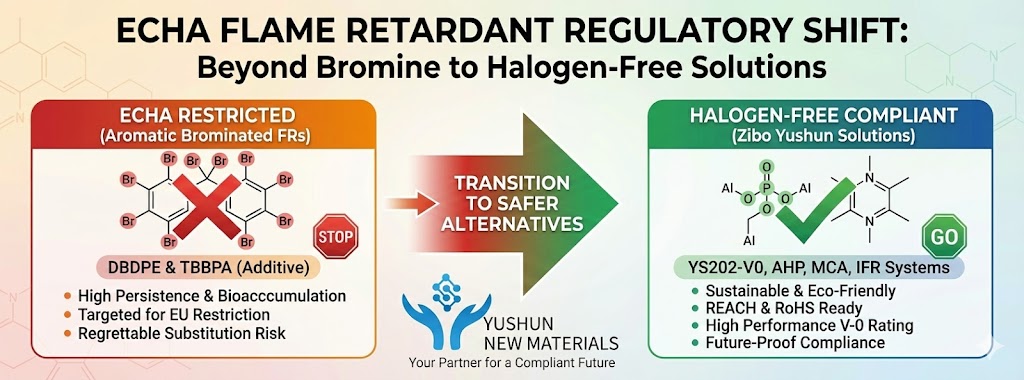
As global environmental directives like RoHS and REACH enforce stricter restrictions on traditional halogenated additives, the polymer industry has decisively shifted toward halogen-free alternatives. Among these, phosphorus-based flame retardants (P-based FRs) have emerged as the industry standard. They operate through highly efficient mechanisms, acting in the gas phase by scavenging free radicals and in the condensed phase by promoting a protective, thermally insulating carbonaceous char layer.
However, the phosphorus FR family is vast and chemically diverse. Selecting the correct molecular structure is critical to preventing the degradation of a polymer’s mechanical, thermal, or electrical properties.
In this technical review, Yushun New Materials breaks down the current landscape of high-end phosphorus flame retardants—from traditional liquid phosphates and the DOPO family to macromolecular solutions—and introduces our advanced proprietary formulations: YS5101 (HPCTP), YS5063, and YSPP17.
1. Traditional & Solid Phosphates: The Battle Against Plasticization
For amorphous engineering plastics like Polycarbonate (PC) and PC/ABS alloys, aryl phosphates are the most common FR additives.
-
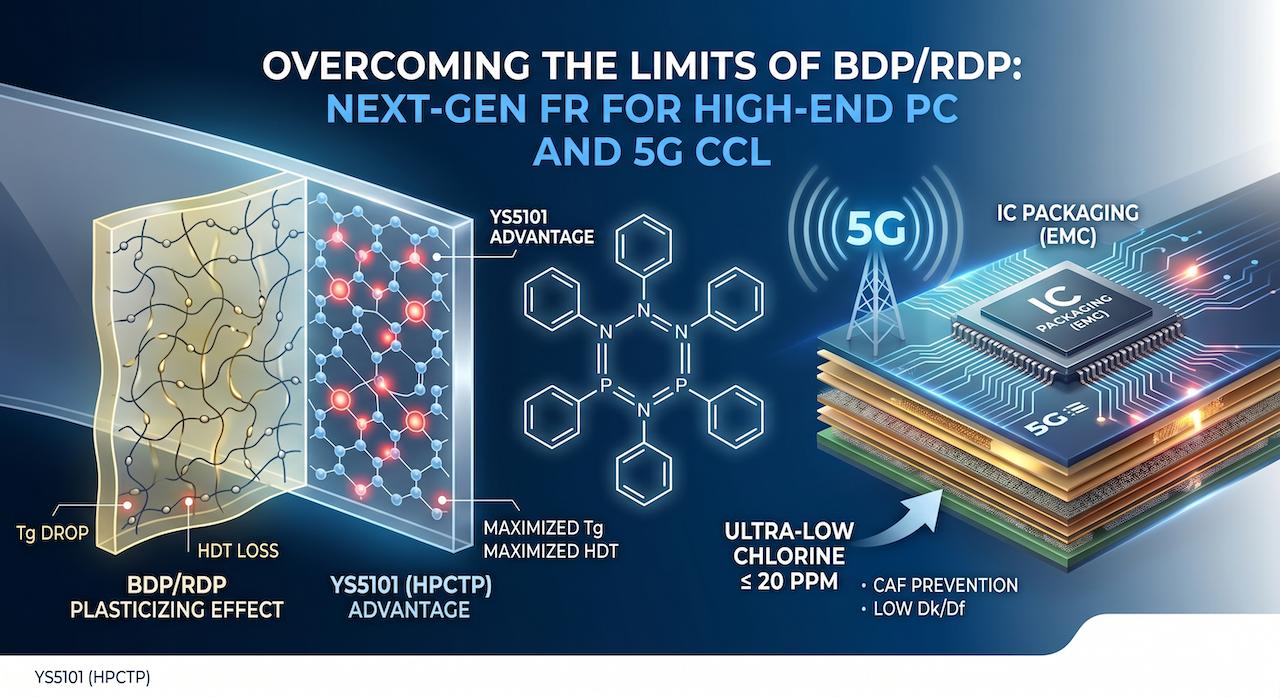
BDP and RDP (Liquid Phosphates): Bisphenol A bis(diphenyl phosphate) (BDP) and Resorcinol bis(diphenyl phosphate) (RDP) are widely used due to their cost-effectiveness and good flame-retardant efficiency. However, their fatal flaw is that they are liquids at room temperature. When added to a polymer matrix, they act as plasticizers, which significantly lowers the Glass Transition Temperature (Tg) and Heat Deflection Temperature (HDT), causing the plastic to become soft and dimensionally unstable at elevated temperatures.
-
PX-200 (Solid Aryl Phosphate): To combat the plasticizing effect, sterically hindered solid phosphates like PX-200 (Resorcinol bis(2,6-xylyl phosphate)) were developed. With a melting point of 95°C, PX-200 overcomes the migration and volatility issues of liquid phosphates, making it suitable for thin-wall PC/ABS injection molding and 5G copper-clad laminates (CCL).
2. Macromolecular Fire Protection: Polymeric Phosphonates
For applications demanding extreme optical clarity, small-molecule additives often cause haze or phase separation.
-
Polyphosphonates: These are high-molecular-weight polymers containing phosphorus. Because they are macromolecules, they achieve molecular-level compatibility with resins like PC and PET, resulting in absolute zero migration. They are the premium choice for creating UL94 V-0 materials that remain as transparent as glass (e.g., aerospace windows and LED covers).
3. The DOPO Family: Reactive & High-Frequency Masters
DOPO (9,10-dihydro-9-oxa-10-phosphaphenanthrene-10-oxide) and its derivatives are characterized by an extremely stable phosphorus-carbon (P-C) bond, offering extraordinary thermal and hydrolysis resistance.
-
DOPO (The Reactive Base): Featuring an active P-H bond, DOPO reacts directly into the epoxy resin network during curing. Because it becomes part of the polymer backbone, it exhibits zero migration, making it the foundational material for halogen-free FR-4 CCL.
-
DOPO-HQ: By incorporating phenolic hydroxyl groups, DOPO-HQ acts as a crosslinking agent. It provides epoxies with a remarkably high Tg (>170°C) and a low Coefficient of Thermal Expansion (CTE), making it essential for semiconductor IC packaging (EMC) where preventing substrate warpage is critical.
-
DIDOPO (Ethane-Bridged DOPO): An additive FR where two DOPO molecules are bridged together, doubling the molecular weight and drastically increasing thermal stability. It easily withstands processing temperatures exceeding 300°C, making it the go-to FR for high-temperature nylons (PA6T, PPA) used in SMT electronic connectors.
-
XDPO (p-Xylylene-Bridged DOPO): By introducing a hydrophobic benzene ring structure, XDPO achieves ultra-low polarity. This translates to exceptionally low dielectric constant and loss (Dk/Df), establishing XDPO as the ultimate FR for 5G/6G millimeter-wave high-speed CCL substrates.
4. The Ultimate Solutions: Yushun New Materials’ Flagship Products
While the aforementioned chemicals address specific niches, Yushun New Materials has engineered proprietary, high-purity flame retardants specifically designed to overcome the most frustrating bottlenecks faced by compounders and formulators today.
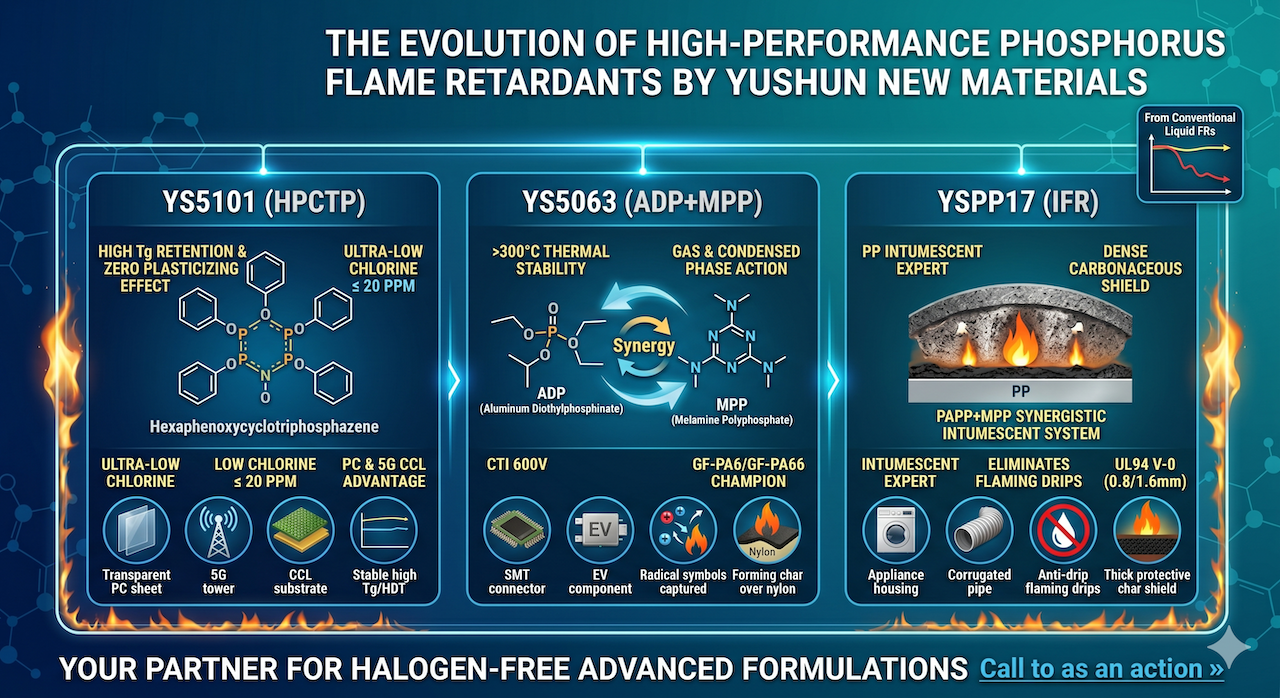
The PC & 5G CCL Guardian: YS5101 (HPCTP)
When traditional BDP or RDP softens your polycarbonate, YS5101 is the definitive upgrade.
-
Chemistry: Hexaphenoxycyclotriphosphazene (HPCTP), CAS 1184-10-7.
-
The “Zero Plasticizing” Advantage: YS5101 features a highly stable phosphorus-nitrogen (P-N) cyclic ring. Unlike liquid phosphates, it is a rigid crystalline powder that achieves UL94 V-0 flame retardancy without compromising the polymer’s rigidity, perfectly preserving the Tg and HDT of PC sheets and modified PPO.
-
Electronic Grade: Boasting an ultra-low chlorine content of ≤ 20 ppm, YS5101 prevents Conductive Anodic Filament (CAF) failures, making it a premier additive for high-frequency 5G CCL and IC packaging.
The High-Temp Nylon Champion: YS5063
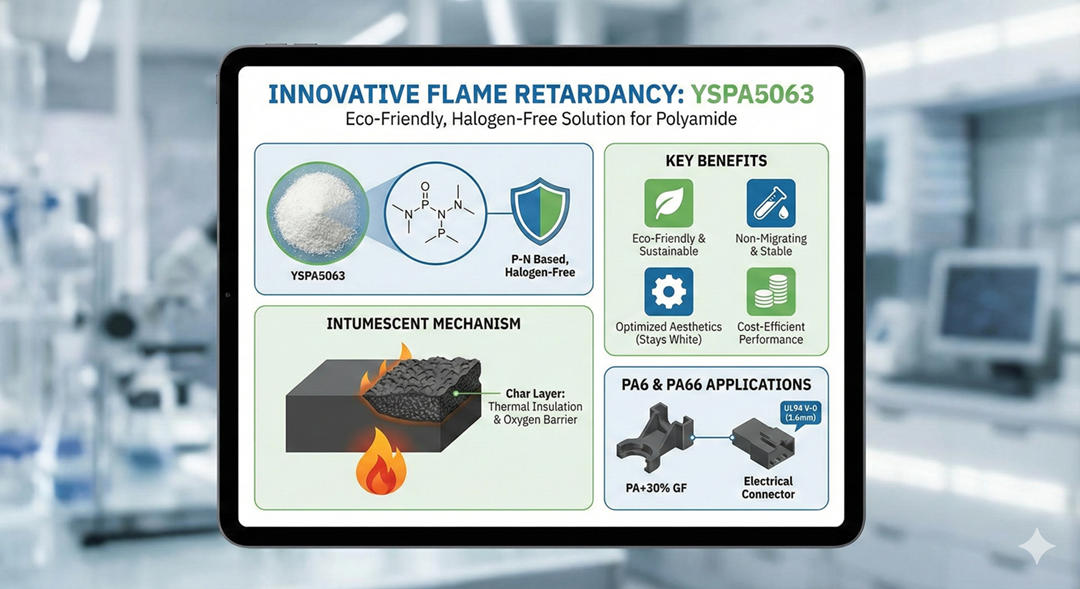
Glass-fiber-reinforced polyamides (GF-PA6, GF-PA66) require processing temperatures where standard FRs decompose and turn black.
-
Chemistry: A synergistic, advanced blend of ADP (Aluminum Diethylphosphinate) and MPP (Melamine Polyphosphate).
-
The Synergistic Advantage: In YS5063, ADP provides extreme thermal stability (withstanding >300°C) and radical scavenging, while MPP acts as a gas-source diluent and char promoter.
-
Performance: This dual-action mechanism easily secures a UL94 V-0 rating while enabling the PA matrix to pass stringent Glow Wire tests and achieve an exceptional CTI (Comparative Tracking Index) of 600V. It is the optimal choice for Electric Vehicle (EV) connectors and electrical switches.
The Polyolefin Intumescent Expert: YSPP17
Polypropylene (PP) is notoriously difficult to flame-retard because it melts and drips heavily while burning, spreading the fire.
-
Chemistry: A highly optimized PAPP + MPP Intumescent Flame Retardant (IFR) system.
-
The Intumescent Advantage: YSPP17 acts simultaneously as an acid source, carbon source, and blowing agent. Upon exposure to fire, it triggers a massive expansion, generating a dense, thick, and non-combustible carbonaceous shield.
-
Performance: This shield completely halts heat and oxygen transfer, abruptly stopping flaming drips. It reliably delivers UL94 V-0 performance in PP for home appliances, corrugated pipes, and automotive interiors.
Partner with Yushun New Materials
The transition to halogen-free materials requires precision chemistry. Whether you need the high-Tg retention of YS5101, the extreme thermal endurance of YS5063, or the robust intumescent protection of YSPP17, Yushun New Materials possesses the R&D capabilities and manufacturing scale to elevate your formulations.
Contact our technical engineering team today to request a Technical Data Sheet (TDS), safety certifications, or a lab sample for your next advanced polymer project.