As industries push the boundaries of materials science—from ultra-thin transparent Polycarbonate (PC) sheets to high-frequency 5G Copper Clad Laminates (CCL)—the demands placed on flame retardants have never been stricter.
While traditional liquid phosphate esters like BDP (Bisphenol A bis(diphenyl phosphate)) and RDP (Resorcinol bis(diphenyl phosphate)) have served as the industry standard for halogen-free flame retardancy, they come with a significant technical compromise: the plasticizing effect.
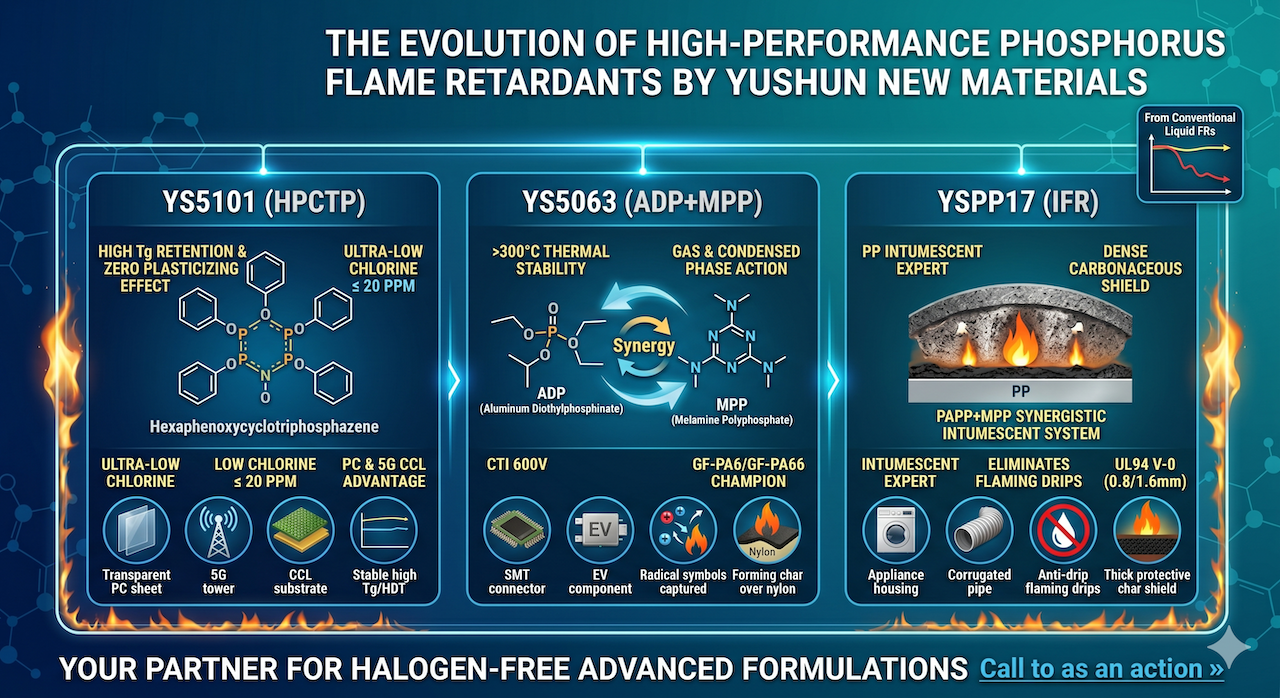
Enter YS5101 (HPCTP – Hexaphenoxycyclotriphosphazene, CAS 1184-10-7). Developed by Zibo Yushun New Materials Co., Ltd., this advanced, electronic-grade phosphorus-nitrogen synergistic flame retardant completely reshapes the performance limits of engineering plastics and electronic substrates.
The PC Challenge: Flame Retardancy vs. Thermal Stability
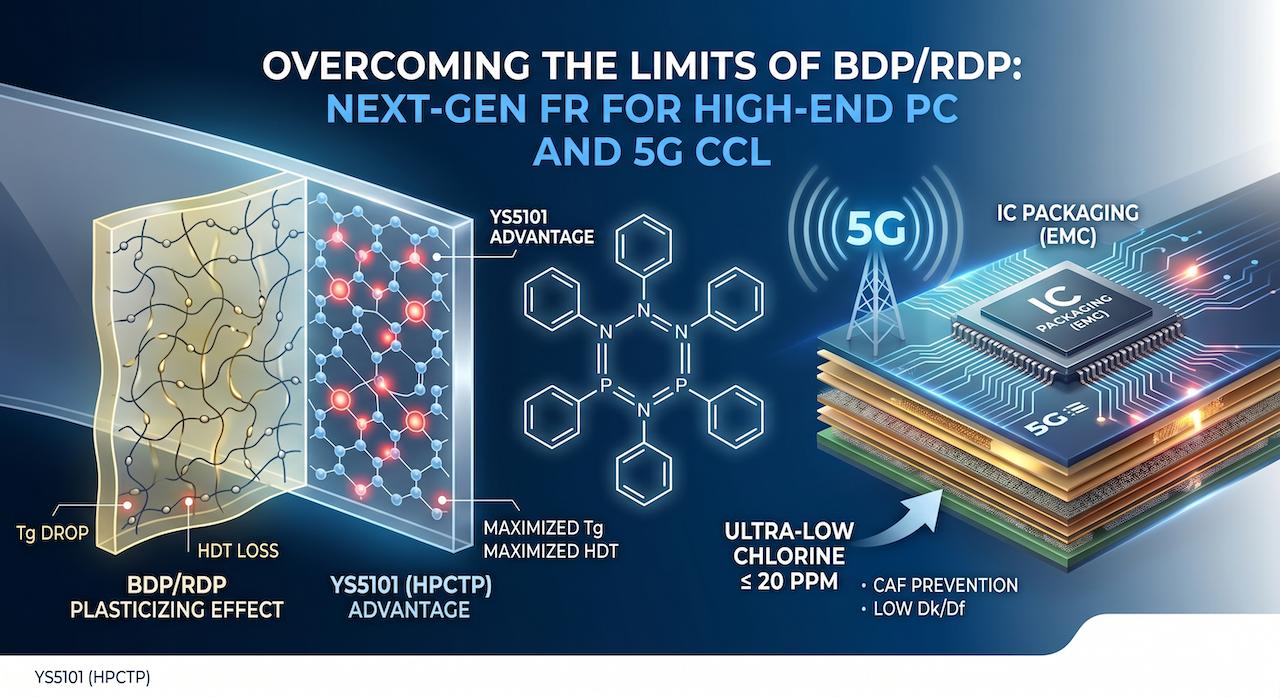
In Polycarbonate and PC/ABS alloys, achieving a UL94 V-0 rating usually requires high loadings of liquid phosphates. Unfortunately, BDP and RDP act as plasticizers within the polymer matrix. This significantly lowers the Glass Transition Temperature (Tg) and the Heat Deflection Temperature (HDT), resulting in “soft” materials that warp or fail under high-temperature service conditions.
The YS5101 Solution: Unlike BDP and RDP, YS5101 is a white crystalline powder characterized by a rigid cyclic phosphorus-nitrogen core. It provides exceptional flame retardancy without degrading the structural integrity of the polymer.
-
Zero Plasticizing Effect: By incorporating YS5101, manufacturers can achieve stringent flame retardancy while maximizing Tg and HDT retention. Evaluation data in a PC matrix shows that an addition of just 4% to 6% YS5101 stably achieves a UL94 V-0 (1.6mm) rating with no dripping, while maintaining an impressive HDT of 112°C.
-
Extreme Thermal Stability: With a 5% weight loss temperature (TG) reaching 350°C, YS5101 easily withstands the rigorous, high-temperature compounding and injection molding processes of PC without decomposing or causing polymer discoloration.
Empowering 5G Electronics: CCL and EMC Applications
The rapid expansion of 5G telecommunications and advanced semiconductor packaging requires substrate materials with flawless electrical reliability and near-zero signal loss. Traditional flame retardants often contain trace impurities or absorb moisture, which leads to Conductive Anodic Filament (CAF) failures and increased dielectric loss.
YS5101 is engineered specifically for the stringent requirements of high-frequency CCL (such as PPO/PPE and Benzoxazine systems) and Epoxy Molding Compounds (EMC):
-
Electronic-Grade Purity: YS5101 boasts a purity of ≥ 99.0% (HPLC) and a strictly controlled free chlorine content of ≤ 20 ppm. This ultra-high purity prevents ionic migration, ensuring superior electrical insulation and long-term reliability in humid environments.
-
Low Dk/Df for High-Frequency Signals: The highly symmetrical and stable P-N ring structure of HPCTP ensures extremely low polarity. This allows high-speed 5G substrates to maintain excellent dielectric constant (Dk) and dissipation factor (Df) metrics, guaranteeing signal integrity.
-
Superior Hydrolysis Resistance: Unlike conventional phosphate esters that can break down into acidic byproducts when exposed to moisture and heat, the robust molecular architecture of YS5101 offers outstanding hydrolysis resistance, protecting delicate integrated circuits from corrosion.
YS5101 Technical Specifications at a Glance
-
Chemical Name: Hexaphenoxycyclotriphosphazene (HPCTP)
-
Appearance: Whitish or white crystal solid
-
Phosphorus Content: 13.40%
-
Nitrogen Content: 6.06%
-
Purity (HPLC): ≥ 99.0%
-
Chlorine Content: ≤ 20 ppm
-
Melting Point: 111-114°C
-
Eco-Profile: 100% Halogen-Free, TPP-Free, and PFAS-Free.
Upgrade Your Formulations Today
Whether you are engineering the next generation of high-heat PC sheets or formulating ultra-low-loss substrates for 5G telecommunications, YS5101 delivers the uncompromised performance your application demands.